


Each year, the Obstbaum Lecture at the American Society of Cataract and Refractive Surgery (ASCRS) annual meeting recognizes leaders who have advanced the field through innovation, clinical insight, and a commitment to improving patient care. Named in honor of Stephen A. Obstbaum, MD, the lecture highlights surgeons whose work has helped shape modern ophthalmic practice.
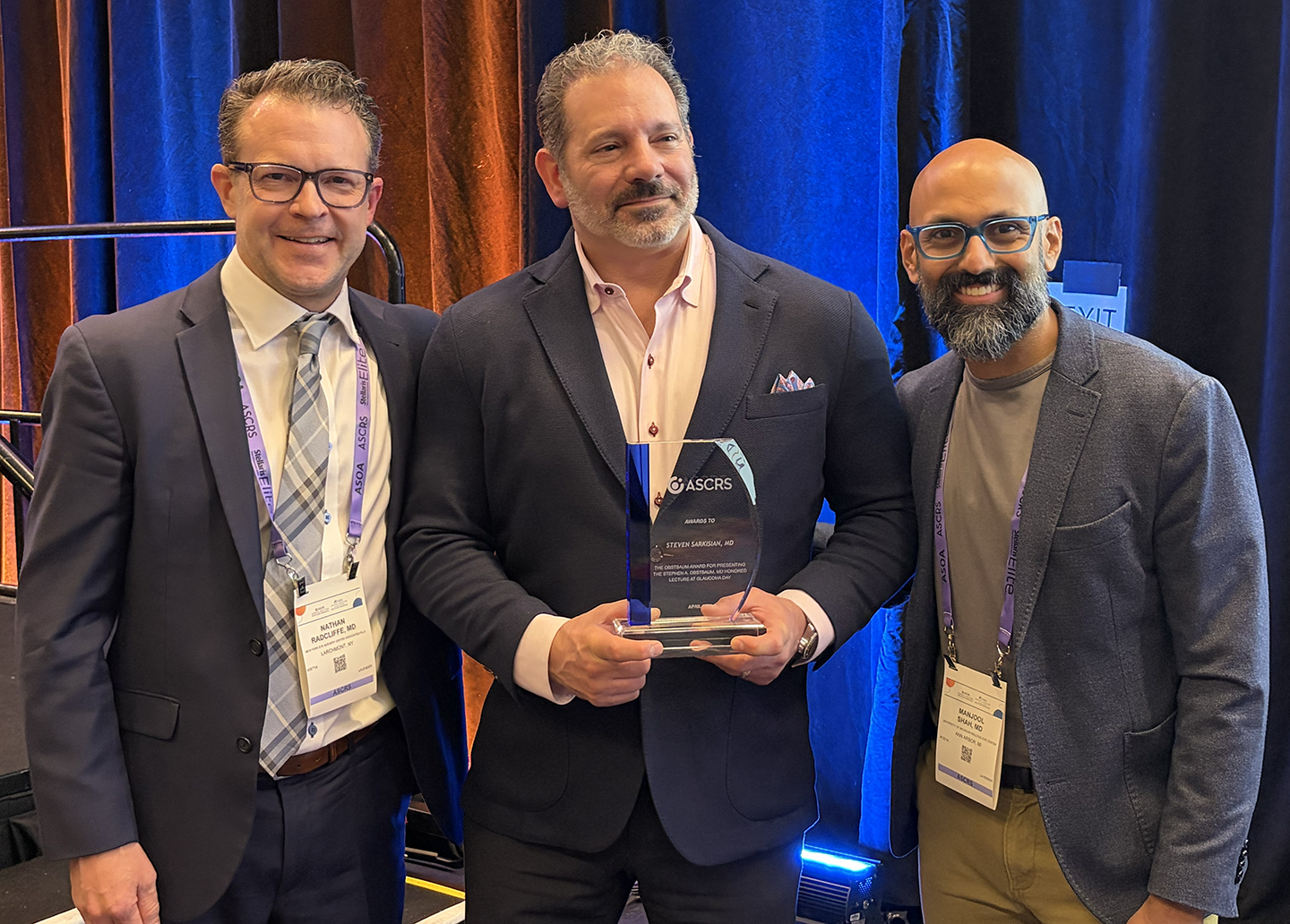
Given that legacy, it is fitting that Steven R. Sarkisian Jr., MD, was selected to deliver this year’s lecture. Over more than 2 decades, Dr. Sarkisian, the founder and CEO of Oklahoma Eye Surgeons, has been an early adopter of interventional surgical approaches to glaucoma and an active participant in the clinical development of many MIGS devices. His career has been defined by a willingness to embrace new technologies, generate clinical evidence, and translate innovation into everyday practice, helping to drive the shift toward earlier, procedure-based management of glaucoma.
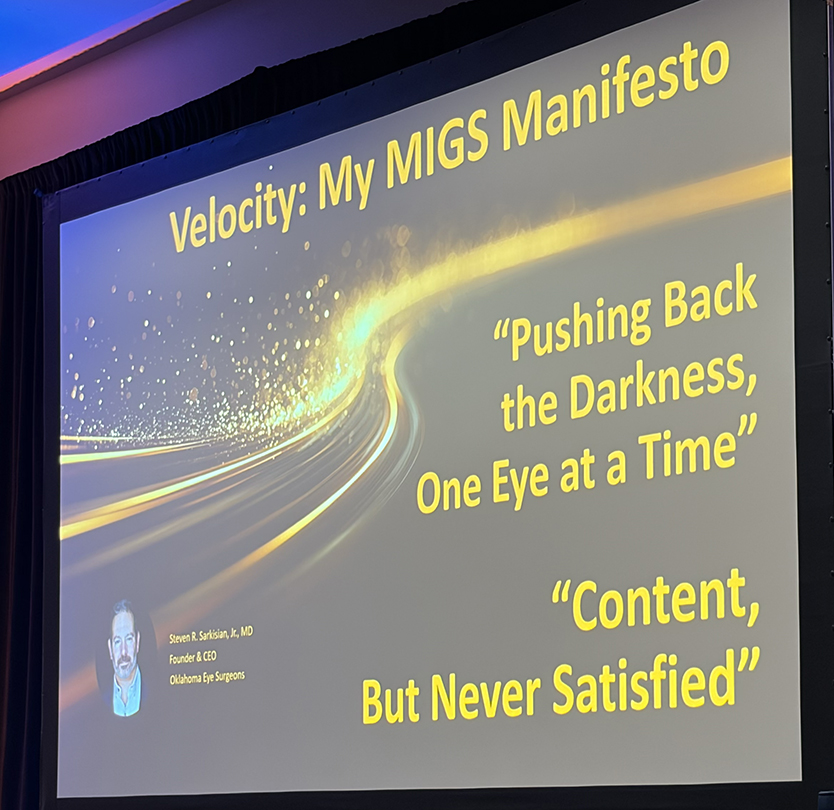
During our conversation, which has been edited for length and clarity, Dr. Sarkisian reflects on the themes of his lecture, titled “Velocity: My MIGS Manifesto,” and discusses the evolution of interventional glaucoma, the importance of urgency in care, and the challenges of bringing new surgical approaches into routine practice.
Glaucoma Physician: What inspired you to frame the talk around the concept of velocity, and how does it reflect the evolution of interventional glaucoma?
Dr. Sarkisian: I originally got the idea for the title from my next-door neighbor, who wrote a book called The Velocity Manifesto. It’s about helping companies adopt new technology and encouraging leadership to embrace change in order to keep up with the market.
When I read it, it really struck a chord with me. It reflects what I’ve tried to do my whole career—recognize early on that glaucoma is a surgical disease and maintain a sense of urgency. I’ve always felt the need not only to adopt new technology quickly and incorporate it into my workflow, but also to bring others along.
That’s really what my talk is about—moments in my career where I was able to do that, and the challenges that came with it. Before interventional glaucoma, it was just “surgery,” and the paradigm was maximally tolerated medical therapy—four medications, then laser, and so on. That’s no longer how we should be thinking.
We’ve reached a point now where the interventionalists have essentially won that conversation. Now we just need to get everyone else on board.
My MIGS manifesto is really about urgency. I’ve always had this sense that we’re in a fight, and the enemy wants to rob people of their sight. When you get into warrior mode, it increases the sense of urgency. That means working with industry, developing better tools, and recognizing that surgery is how we definitively address the disease. Medical therapy can delay things, but surgery is how we win. That’s why I frame it as a manifesto, because it’s about acting with urgency and embracing interventional glaucoma.
GP: How has your career influenced your perspective on earlier and more proactive surgical intervention?
Dr. Sarkisian: In my talk, I emphasize that glaucoma is a surgical disease. I came to that realization shortly after my fellowship. I trained with Peter A. Netland, MD, PhD, who emphasized safety first—prioritizing safer ways to lower pressure.
Throughout my career, whether in cataract or glaucoma surgery, the goal has been to lower IOP safely. That led me from trabeculectomy modifications, like the Ex-Press shunt, to canaloplasty, and eventually to MIGS procedures.
When evidence didn’t exist, we worked to create it. That’s been a defining part of my career—using clinical intuition, testing ideas, and building the evidence base. I’ve also worked closely with industry, often helping refine concepts and push them forward.
There’s a real sense of urgency. Patients are losing vision, and we don’t have time to move slowly. For example, in severe glaucoma, hypotony after trabeculectomy can carry a meaningful risk of vision loss. We need safer alternatives that still achieve meaningful pressure reduction.
That’s been my role—not just adopting new techniques, but helping others understand and adopt them as well.
GP: What do clinicians still underestimate about intervening earlier?
Steve Sarkisian, MD: Physicians are often victims of their training. They learn a certain way of doing things and become comfortable with it. But to truly serve patients, you have to be willing to be uncomfortable.
You have to pursue a state of dissatisfaction. I often say I’m content but never satisfied. You have to keep asking, “Can we do this better?”
If you’re not doing that, you’ll be left behind. The pace of change is too fast. Patients are making decisions based on new technology, and if you’re not offering it, they will go elsewhere.
It’s no longer acceptable to perform cataract surgery on a glaucoma patient taking multiple medications without offering a MIGS procedure. It’s also not acceptable to have nothing between phaco-MIGS and trabeculectomy. There are too many options now.
You have to adapt. Most of what I do today, I didn’t learn in training. You have to want that change.
GP: What are the biggest challenges to fully adopting interventional glaucoma?
Steve Sarkisian, MD: One of the biggest barriers is reimbursement. It influences behavior—not because physicians are driven by payment, but because we don’t want patients to face unexpected costs.
Early adopters often build systems to navigate this, but not everyone has that ability. For example, when iDose was first introduced, my practice was among the first to submit for Medicare reimbursement. It took months of effort—letters of medical necessity, appeals—before it became routine.
That’s part of the work: making these innovations accessible so others don’t have to go through the same process.
That said, even when reimbursement improves, adoption isn’t universal. Some surgeons are reluctant to change their workflow or extend surgical time. Others are hesitant to learn new techniques.
We saw this with phacoemulsification—some surgeons resisted it until it became unavoidable. I think we’ll see a similar pattern with interventional glaucoma. My concern is that some patients will continue to receive outdated care because their physicians are reluctant to adopt new approaches.
GP: What does delivering the Obstbaum Lecture mean to you?
Steve Sarkisian, MD: When I look at the list of prior speakers, many of them are people I consider heroes. It’s humbling to be included among them.
It does feel like validation of the work that my colleagues and I have done over the years. Early in my career, advocating for surgical intervention in glaucoma wasn’t always well received. Now, to be recognized as a pioneer in interventional glaucoma is meaningful.
At the same time, it makes me more restless. There’s still so much work to do. I don’t want us to be doing the same things 10 years from now. Ideally, 60% to 80% of what we do today will be obsolete.
That’s how progress should work. The next generation will come along and improve on what we’ve done. That’s what I’m excited about. GP