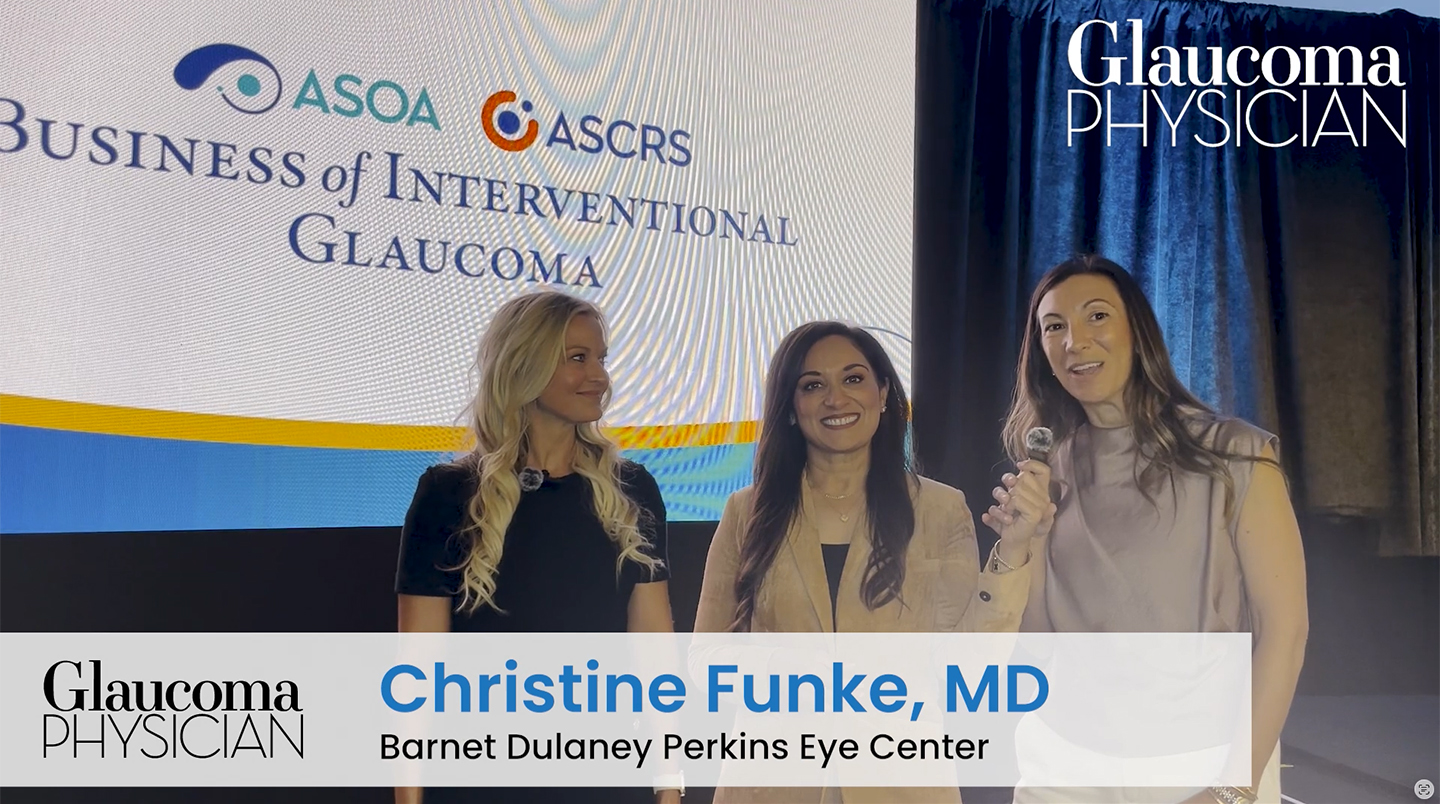
The following transcript has been edited for clarity:
Hi, I’m Deb Ristvedt, DO, from Vance Thompson Vision in Alexandria, Minnesota.
And I'm Zarmeena Vendal, MD, from Austin, Texas.
And Christine Funke, MD, from Phoenix, Arizona, at Barnet Dulaney Perkins.
Dr. Ristvedt: We’ve just finished a wonderful day at Business of Interventional Glaucoma. And this is recently kind of a new thing. We've put this on the last 2 years, and interventional glaucoma is specifically a new buzzword that a lot of people are learning more about. What does interventional glaucoma mean to you guys?
Dr. Vendal: Deb, 19 years in Austin at Westlake Eye, I think what we've learned is interventional means proactive, not reactive. So acting ahead of the curve to prevent glaucoma from getting worse, as opposed to after the fact.
Dr. Funke: I totally agree. This is just also a new way of looking at a disease we've all been treating for a very long time and getting a new perspective on how we want to take care of patients, which is taking the burden away from them. We've always put the burden on patients in terms of drop therapy. Now we can say, we'll take on the onus and we really want to own that procedure, use them often and early because that’s when we are most effective. And again, try and give patients some of that mentality of how we are trying to change and shift the treatment of a really challenging disease.
Dr. Ristvedt: Yes. And this is the Business of Interventional Glaucoma, so there's a lot of administrators here today learning about how they need to run their practices differently and how to collaborate not only with their surgeons and optometrists, but also how they can better educate patients as well as referring networks. What do you guys feel has really worked in your practice to truly become interventional when it comes to building the consultation?
Dr. Funke: I think one thing I've learned is that I started this on my own. It was like my personal journey first of becoming more interventionally forward. And then I quickly realized that I can only do so much myself. And I really need a team around me and there's nothing better than your administrative having your back. The administration, we need people to make processes around us. I'm good at discussing disease, treating disease, but I may not be as good at understanding how the flow is for our patients coming in and out of our practice. So having somebody who can take on the ownership of that piece and take it off of my plate, nothing better. And then once you have that in place, they can help you grow towards your community to understand what we're doing, what we're trying to do, and help them educate all those around us, both internally and externally, on how we want to shift the paradigm of glaucoma treatment.
Dr. Ristvedt: How about you, Zarmeena?
Dr. Vendal: I love that. I think what I would add to that is creating a central mission. So a company mission that everybody ascribes to, that's what's really worked for us, which is the doctors and the administrators really believe in the interventional glaucoma mission and then that percolates down to all the staff. So really a company culture and starting with that, number one, before we do all of the other things that Christine just described—I think that is a setup for success.
Dr. Ristvedt: And it truly takes a village. We talked about the patient experience cycle and how it starts with our phone team, talking to these patients and getting them into our practices. They understand now what goes into being truly interventional with diagnostic testing being done early, with making sure that we communicate with our referral network early in the process so they don't feel like they're going to have their patients taken away from them. We’re actually integrating that and building trust so that we can all work together as a team.
But I truly love how our techs will say, "Hey, I was just talking to Mrs. Jones, and she's on a medication and she really is struggling to get it in with her arthritis. She has fluctuating vision and burning, so I told her that there's other options out there.” Wow! It’s like music to my ears, when our team is so vested in patient care where they know that they're making a difference.
Dr. Vendal: Yeah, that's when you know you're taking care of the patient as a whole. When our staff is educated enough to talk to patients about the things that matter to them and that we're actually making a difference in their quality of life, not just in their disease. So I love that we are all on the same page and then the patients in the center of that conversation.
Dr. Funke: I think for those of you who are seeing this video and are interested, know that this isn't going to be the last of this group getting together and talking about really truly the business component of interventional glaucoma because I think a lot of us talk at the meetings about interventional glaucoma and why. This is way more of the how. And I think that a lot of us have gotten the why, but now we just don't know how to integrate that personally into our practices. So for those of you out there who that's what boat you're floating in, come and join next time because I think that this day is well worth the time. And not just as an MD, but we’ve had ODs here and all the practice administrators who are really learning how to support the ophthalmologists who are trying to make this move.
Dr. Ristvedt: Thank you everyone for joining us. And we've had, again, the most incredible day. We hope to see you next year. GP