





Minutes before I sat down to write this article—which may or may not have been minutes before its deadline—I encountered a colleague at my ASC who had been struggling to resolve a 1-week-old hyphema. He explained the situation to me and another surgeon: approximately 95% of the hyphema had been cleared, but a small clot remained over the nasal goniotomy site. A gentle attempt to remove the residual clot immediately triggered a triumphant rebleed. Almost simultaneously, the other surgeon and I—performing the familiar role of Monday-morning quarterbacks—remarked, “Perfect is the enemy of good.” Neither of us appreciated at that moment that we were quoting Voltaire.
This encounter sparked the central question of this article: Has the field of glaucoma developed, or adopted, its own surgical aphorisms?
An aphorism is typically defined as a concise, memorable statement that conveys a broader principle or truth. Medicine, and especially surgery, is fertile ground for aphoristic wisdom, perhaps because so many complications seem obvious only in retrospect. Glaucoma, with its unpredictable disease course and occasionally unforgiving surgical outcomes, may be a domain where such guiding statements are particularly valuable.
Most medical doctors were introduced to aphorisms during their general surgery rotation, and many of these apply seamlessly to glaucoma. Trabeculectomy and tube-shunt surgery readily evoke the oft-quoted maxim, “If you don’t want complications, don’t operate.” One of the special privileges of aphorisms is that they need not be internally consistent. At times one may fully agree with statements such as, “A chance to cut is a chance to cure,” or “It takes cold steel to heal,” and moments later head nod to the counterbalancing doctrines, “The difference between a good surgeon and a great surgeon is knowing when not to operate,” or “Sometimes the best operation is no operation.”
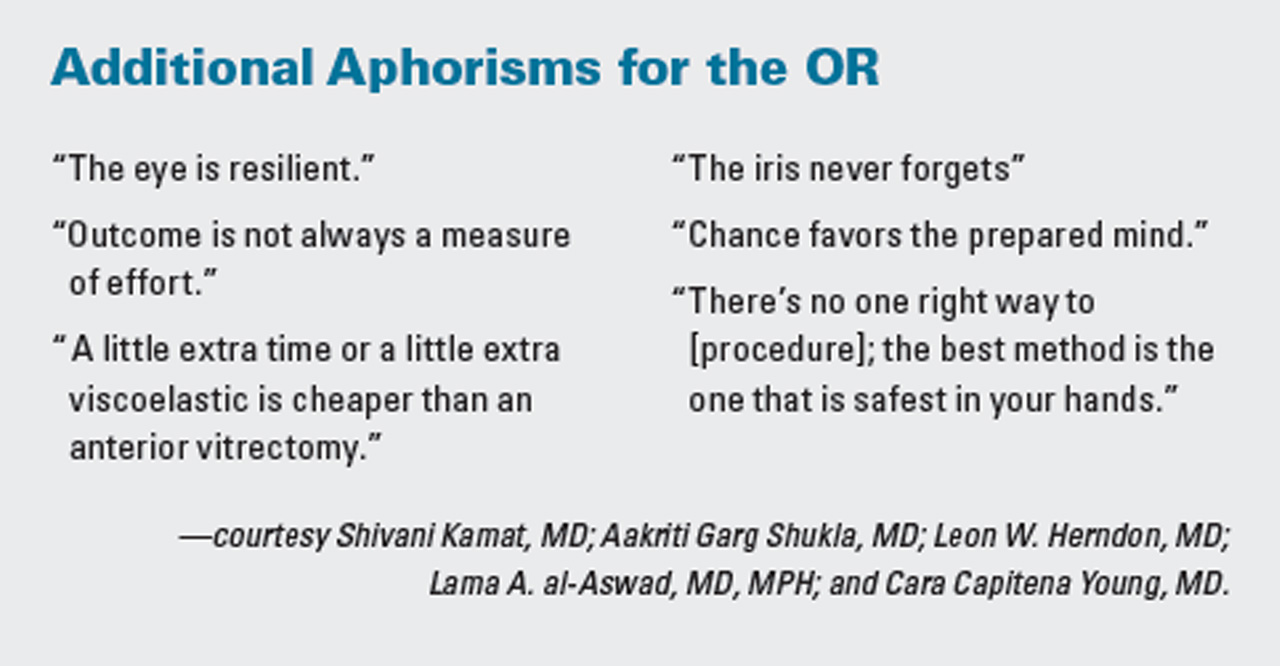
But what statements arise specifically within glaucoma surgery? Many of us have encountered—and personally felt—the truth embedded in, “The only thing worse than high pressure is no pressure.” Another aphorism, deriving loosely from Sir William Osler, resurfaced during a meeting in which numerous mitomycin-C (MMC) delivery techniques were presented. A senior surgeon remarked, “Anytime there are multiple ways to do something, it is usually because either all of them work or none of them work.” This observation seems broadly applicable, not only to MMC techniques but also to trabeculectomy variations, approaches to all incisional surgery, and perhaps glaucoma management as a whole.
It bears acknowledging that if glaucoma care were uniformly predictable, we would have little need for aphorisms. Their existence implies a measure of uncertainty, often accompanied by a touch of cynicism. Years ago, while watching surgical complication videos at a conference, I witnessed an especially startling event: during what appeared to be a routine glaucoma procedure, a surgical instrument was withdrawn from the eye, and the iris followed it out entirely. The audience gasped. A colleague quietly murmured, “There are so many ways to lose in glaucoma.”
For some surgeons, aphorisms evolve into a guiding philosophy. In my own practice, a minimalist approach has developed from a collection of them. From primum non nocere and “Less is more” to “The more steps an operation has, the more opportunities there are for something to go wrong,” these principles have shaped my decision-making. I strive to limit medication changes, procedural steps, and—hopefully by extension—potential complications. Still, as the statement oft-misattributed to Einstein reminds us, “Make everything as simple as possible, but not simpler.”
Aphorisms endure partly because they are powerful teaching tools. As a surgical intern, I never needed explicit instruction to avoid the pancreas—I had already heard the warnings. If we can impart similarly memorable guidance to our trainees, we may spare them and their patients unnecessary hardship. One experienced glaucoma surgeon recalled his fellowship mentor’s advice: “The most important step of this surgery is preparing in your mind what the next surgery may need to be.” Another pair of aphorisms illustrates the conflicting directives that often accompany surgical training: “Don’t just stand there—do something!” contrasted with “Don’t just do something—stand there.” (As a former resident instructor, I usually go with the latter.)
Ultimately, aphorisms remind us that we are not the first to confront surgical setbacks; complications are an inherent part of the art of medicine. And while glaucoma management can be challenging, it helps to maintain perspective. Returning to the colleague with the recurrent hyphema: at least neither of us chose to offer the darkly reassuring maxim, “All bleeding stops eventually.” GP